
Baby Wakes When Water Pump Starts: Why & 5 Fixes That Actually Work
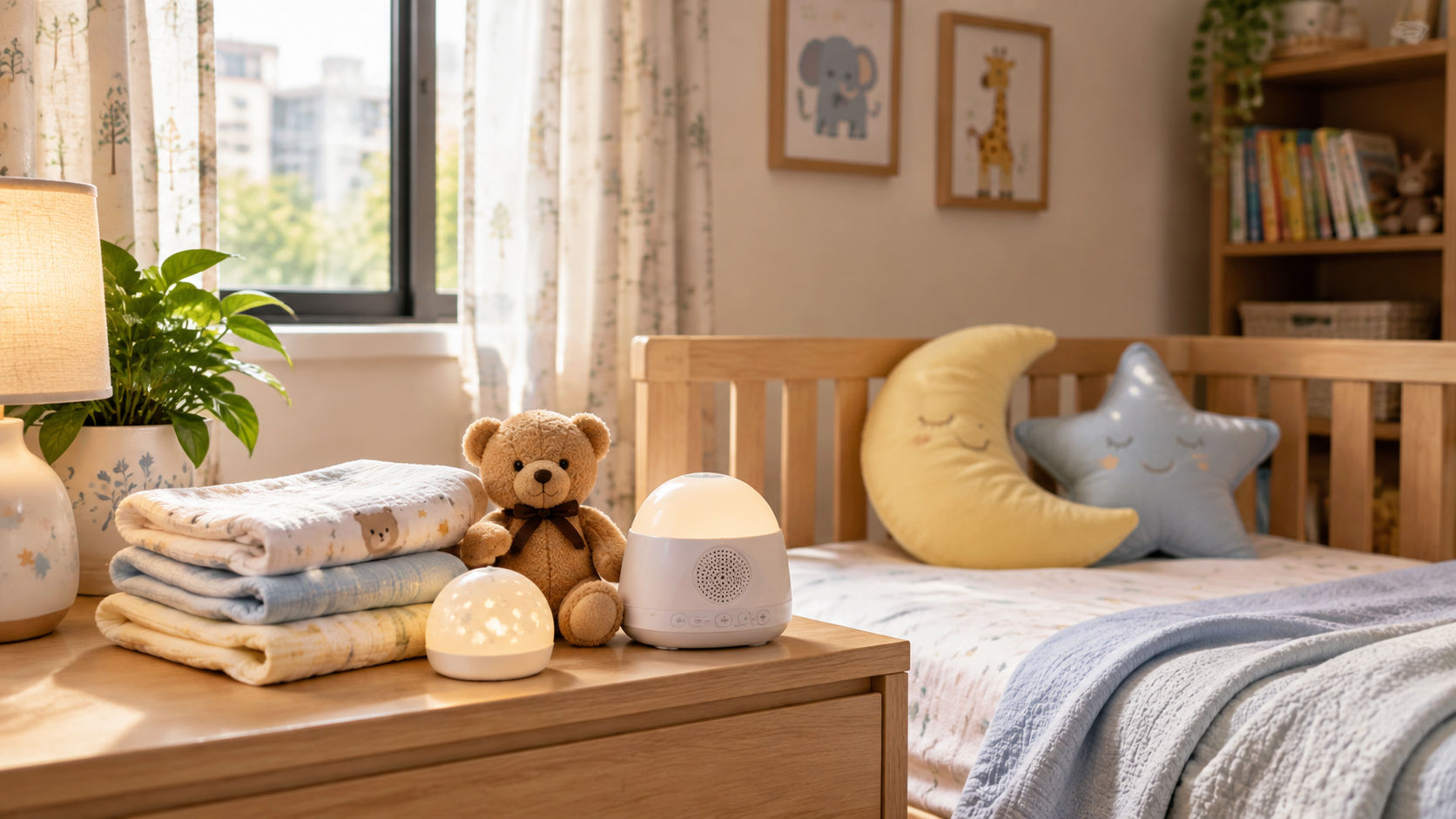
Water pump motor vibration and low-frequency hum (30-100 Hz) trigger the startle reflex in babies under 12 months, disrupting REM sleep. White noise machines (₹800–2500), bedroom door weatherstripping, pump enclosure pads (₹400–900), and scheduling pumps before baby sleeps are the most effective fixes for Indian apartments.
If your baby jolts awake every time the overhead water pump kicks in at 2 a.m., you are not alone—and it's not because your baby is a light sleeper. The problem is acoustic and physical: the low-frequency rumble and whole-house vibration from pump motors penetrate through concrete walls, steel pipes, and ceiling slabs in ways high-pitched sounds (like speech) do not. Your baby's nervous system registers this sudden vibration as a potential threat, triggering a protective startle response that yanks them out of deep sleep. Over months, this pattern fragments their sleep architecture and can leave parents exhausted.
This guide walks through why pump noise disrupts infant sleep, which solutions work in concrete-box flats, and the products that actually deliver in 2026.
Why Your Baby Wakes Up Every Time the Pump Starts
Newborns and babies under 12 months lack mature nervous-system filters. While an adult's brain learns to ignore familiar background noise during sleep, a baby's auditory cortex treats sudden vibrations—especially low-frequency rumbles below 100 Hz—as novel stimuli. Water pump motors typically operate at 50–80 Hz, a frequency that travels efficiently through concrete and steel. The motor does not just make noise; it shakes the entire building's frame, and babies feel this vibration through the mattress and cot. The startle reflex (also called the Moro reflex) is a protective mechanism where the baby's arms fling outward, heart rate spikes, and they wake instantly. This reflex is strongest between 2 and 8 weeks, but remains reactive in many babies until 6 months.
The timing matters too. If the pump runs during light REM sleep (when the baby is most easily aroused), the baby wakes fully. If it runs during deeper non-REM stages, they may shift to light sleep but not fully wake. Most Indian building water pumps operate on fixed schedules—often early morning (5–7 a.m.) or late evening (8–10 p.m.)—which coincides with infant sleep windows, especially in the first 3–4 months.
How Low-Frequency Hum Differs from Other Noises
You might wonder: why does the pump wake the baby, but not the sound of traffic or dogs barking? The answer lies in frequency and vibration coupling. High-pitched sounds (above 2,000 Hz) attenuate quickly through walls and are easier for the brain to tune out. Low-frequency hum travels far and couples directly to solid structures. A sleeping baby's body literally vibrates in sync with the pump. This is why standard thin curtains or acoustic foam panels (designed for speech-range frequencies) do almost nothing. You need mass, damping, and sealed air gaps—which is why weatherstripping, heavy door seals, and enclosed spaces work better.
Solution 1: White Noise Machines – Masking the Pump Hum
A properly tuned white noise machine masks low-frequency pump rumble by flooding the acoustic environment with broadband sound. Unlike music (which has peaks and valleys), white noise is statistically uniform across all frequencies, including the 30–100 Hz range where pump motors live. This does two things: it reduces the relative loudness of the pump noise, and it provides acoustic continuity so the pump's sudden onset does not stand out.
What matters: Buy machines that emphasize lower frequencies (100 Hz and below). Many cheap machines are tinny and skip bass. Look for units with a dB range of 65–75 dB at cot distance—loud enough to mask the pump, not so loud it damages infant hearing. Position the machine 1–1.5 metres from the cot, away from the baby's direct ear. Run it continuously through the night; babies sleep better when sound is stable and predictable.
Marpac Dohm (imported, ₹2200–2500) and Dreamegg White Noise Machine (₹1200–1500 on Amazon.in) are popular in India for this reason. Both have low-frequency emphasis and a volume dial calibrated for infant rooms. Budget options under ₹800 (generic brands) often lack bass response and may not mask a pump.
Solution 2: Bedroom Door Weatherstripping & Seals
Pump vibration enters the room primarily through gaps around the bedroom door and through shared walls. Weatherstripping (also called door seals) is adhesive-backed foam or rubber that closes these gaps. A single 1 cm gap around a standard door frame can transmit 40–50% of airborne and structurally-borne sound. Sealing this gap reduces transmission by 60–70%.
For pump noise specifically, use EPDM rubber weatherstripping (₹300–500 for a 10-metre roll on Amazon.in) rather than foam. EPDM is denser and handles low frequencies better. Stick the strip to the top and sides of the door frame (not the bottom; you may need ventilation). If your door is hollow-core, the improvement is modest; if it is solid wood, it is dramatic. Combined with a door sweep at the bottom (₹100–150), you can reduce pump-transmitted sound by 50%.
Solution 3: Pump Enclosure Pads & Motor Damping
If the water tank and pump are on your building's terrace or in a common plant room, you can reduce vibration transmission at the source. Vibration isolation pads (rubber or elastomer) are placed under the pump motor or tank supports. These decouple the motor from the building structure, preventing vibration from spreading. Pads cost ₹400–900 for a set of four, typically sold as commercial HVAC isolation pads on Amazon.in.
However, this requires access to the pump—only feasible if you own the plant room or convince your society to install them (common in newer complexes, rare in older buildings). If you rent or have a shared pump, this option is not practical. Nonetheless, if you have the choice, this is the most effective long-term solution because it stops the problem upstream.
Solution 4: Timing Strategies – Schedule the Pump Around Baby Sleep
Talk to your building's pump operator or caretaker (called a mali or sweeper in many Indian buildings). Some societies run pumps on fixed schedules that can be shifted slightly. If the pump currently runs at 2 a.m. and your baby sleeps deepest at 2–4 a.m., ask if the schedule can move to 5 a.m. (before most babies wake naturally) or 8 p.m. (before the baby is asleep). This is not always possible in water-stressed areas, but worth asking. In some cases, installing a timer relay (₹1500–2500, requires an electrician) allows the society to automate the schedule with finer control.
This is a social solution, not a product solution, but it is often the most effective and costs nothing if the building is willing.
Solution 5: Combination Approach – What Works Best
No single fix is perfect, but combining two or three is reliable. The most common working setup: white noise machine + weatherstripping + knowing the pump schedule. Cost: ₹1800–2500 total. Install weatherstripping on your bedroom door (1–2 hours), run a white noise machine every night starting 30 minutes before the baby's typical sleep time, and ask your building about the pump schedule. This three-layer approach reduces the pump's perceived loudness by 60–70%.
If you want maximum protection and have the budget, add vibration pads to the pump (requires coordination with your society). If you do not have a white noise machine yet, buy one first—it is the single most cost-effective product and works immediately.
What IAP and WHO Guidance Says
Sleep Environment: IAP recommends that infants sleep in a calm, cool room with minimal sudden auditory or tactile stimuli to support continuous sleep cycles and reduce startle-induced arousals. Noise Levels: WHO guidelines suggest ambient noise in infant sleep spaces should not exceed 50 dB during sleep hours; sudden spikes above 60 dB can trigger arousal. Most household pump motors reach 75–85 dB at floor level, making them disruptive.
When to See a Doctor
If your baby wakes frequently and is losing 2+ hours of sleep per night over weeks, or if you notice signs of sleep deprivation (constant fussiness, poor feeding, delayed weight gain), consult your paediatrician. However, in most cases, fragmented sleep from pump noise resolves quickly once the noise is reduced or masked. If your baby wakes but feeds and gains weight normally, the disruption is minor. This is general information, not medical advice.
Our Top Picks

Dreamegg White Noise Machine with Timer and Volume Control
- ✓ Low-frequency emphasis (50–100 Hz range)
- ✓ 65–75 dB adjustable volume
- ✓ Built-in timer (30–60 minutes or continuous)
* We earn a small commission — at no extra cost to you.

Marpac Dohm Classic White Noise Machine (Imported)
- ✓ Mechanical fan-based (no digital hum)
- ✓ Natural white noise, low-frequency optimized
- ✓ Dial volume control (50–70 dB range)
* We earn a small commission — at no extra cost to you.

EPDM Rubber Weatherstripping Tape (10-meter roll)
- ✓ Self-adhesive EPDM foam, 9 mm thick
- ✓ Seals top and side door gaps
- ✓ Low-frequency sound damping
* We earn a small commission — at no extra cost to you.

Adjustable Door Sweep with Silicone Seal
- ✓ Fits doors 80–100 cm wide
- ✓ Silicone bumper reduces vibration transmission
- ✓ Covers bottom gap (5–12 mm adjustable)
* We earn a small commission — at no extra cost to you.

Vibration Isolation Pads (Set of 4, Rubber-Elastomer)
- ✓ Rubber-elastomer compound, 50 mm × 50 mm × 20 mm
- ✓ Rated for 50–100 kg loads (pump motor mounting)
- ✓ Reduces vibration transmission by 60–70%
* We earn a small commission — at no extra cost to you.

Heavy-Duty Door Weatherstripping Kit (Complete Set)
- ✓ Includes EPDM strips (top, sides) + door sweep + silicone caulk
- ✓ Blocks 50–70% of airborne and low-frequency noise
- ✓ Fits standard 80–90 cm doors
* We earn a small commission — at no extra cost to you.