
Shape Recognition Activities for 18-24 Month Olds: 5 No-Toy Home Activities
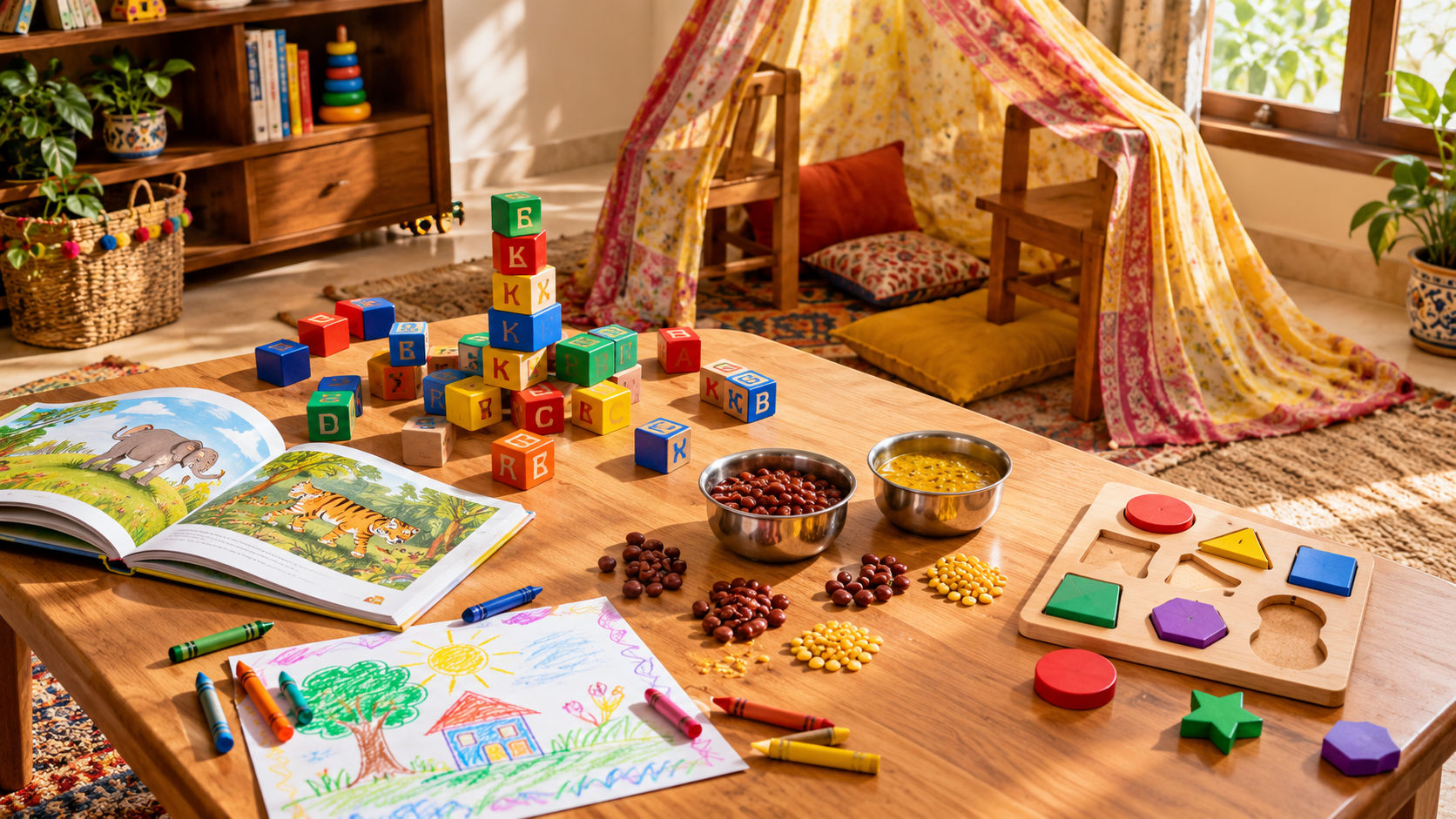
Toddlers aged 18–24 months recognize circles, squares, and triangles through hands-on exploration, not flashcards. Use rotis (circles), paratha (squares), and thepla (triangles) for finger-tracing; sort lids by shape; walk masking-tape shapes on the floor; find real-world circles on walks; stamp shapes with cut vegetables in flour. All activities use what's already in your home.
Between 18 and 24 months, toddlers move from identifying shapes as interesting visual patterns to beginning to recognize and name them consistently. This is embodied learning: understanding happens through movement, touch, and real objects—not worksheets or digital flashcards. If your child is 18–24 months old and you want shape recognition activities for home, you don't need to buy anything. This guide shows five tested activities using rotis, dabbas, paratha, thepla, flour, and a roll of masking tape.
What's happening at this age
At 18 months, most toddlers notice shapes but treat them as decorative details. By 24 months, they begin to identify circles, squares, and sometimes triangles—especially when they've handled them repeatedly. According to the National Education Policy 2020 (NEP), early learning of spatial concepts builds the foundation for numeracy and geometry later; the focus at this age should be sensory exploration and movement, not naming accuracy.
Your child's brain is wiring connections between the shape they see, the shape they touch, and the word you use. This happens fastest when the shape is something they can manipulate—a roti they've watched you make, a lid they can pick up, a path they can walk on. Repetition across different contexts (a circle in a paratha, a circle on a walk, a circle they draw) locks the learning in.
Try this at home
Activity 1: Trace Shapes with Finger on Rotis, Paratha, and Thepla
You need: A warm roti (circle), a paratha (square), a thepla (triangle), your finger, and a kitchen table.
How: After you've made rotis or paratha for a meal, let your toddler sit at the table while one is still warm (but safe to touch). Guide their finger around the edge of the roti in a slow circle, naming it: "This is a circle." Repeat with paratha (square tracing) and thepla (triangle). Do this 2–3 times per week during normal meal prep—it takes 3 minutes per session.
What it builds: Hand–eye coordination, fine motor control, and the visual pattern of each shape linked to touch and a word.
Easier: Trace the shape yourself while your child watches and names it. Harder: Ask "Where is the corner?" on a square and let them point.
Activity 2: Sort Lids by Shape into Two Baskets
You need: Round lids (from jars, containers, dabbas), square lids (from storage boxes, tiffins), two small baskets or containers, a kitchen floor or mat.
How: Place 6–8 lids on the floor—a mix of round and square. Show your child how to pick up a round lid, say "Circle," and drop it into one basket. Then a square lid: "Square." Let them do the sorting. Expect some mistakes; that's normal at this age. Repeat weekly.
What it builds: Shape discrimination, categorization, and gross motor skills (reaching, bending, releasing).
Easier: Use only round and square; skip triangles. Harder: Add triangle-shaped items (folded paper, a cut-out card) and a third basket.
Activity 3: Walk a Masking-Tape Shape Path on the Floor
You need: One roll of painter's masking tape (safe on most floors, lasts 2–3 weeks), a clear floor space (hallway or living room), your voice.
How: Tape a large circle (about 1 metre in diameter) on the floor. Hold your child's hand and walk around it slowly, naming: "We are walking on a circle." Repeat the walk 3–5 times. Next week, tape a square. Do this fortnightly with a new shape. The tape is a visual and tactile guide; your child learns shape through the rhythm of movement.
What it builds: Gross motor skills (balance, walking, awareness of space), and shape recognition through whole-body movement.
Easier: Make a smaller circle (50 cm). Harder: Tape two shapes and alternate between them.
Activity 4: Find Circles, Squares, and Triangles on a Walk
You need: A 15-minute local walk (a lane, park, or market street) and your naming.
How: Point out real-world shapes as you walk: "Look, a circle—that's a manhole cover." "That clock is a circle too." "The window is a square." "That rooftop is a triangle." Repeat the same shapes on multiple walks so your child's brain links the name to the real-world object. This builds the idea that shapes exist outside the home.
What it builds: Shape recognition in real contexts, vocabulary, observation skills, and the understanding that shapes are everywhere.
Easier: Point out only circles for the first few weeks. Harder: Ask "Can you find a square?" and wait for them to point.
Activity 5: Stamp Shapes in Flour with Cut Vegetables
You need: A shallow tray or large plate, a cup of flour, half a lauki (bottle gourd—cut into a circle) or a piece of cauliflower (naturally bumpy), a triangular piece of capsicum, or a square piece of bread.
How: Spread flour thinly in the tray. Show your child how to press the lauki half into the flour to make a circle print. Then a triangle (capsicum piece). Lift the vegetable—a shape remains pressed in the flour. Let them repeat. This combines sensory exploration (the feel of flour, the texture of vegetables) with visual imprint of shapes.
What it builds: Fine motor strength, the link between an object and the shape it creates, and cause–and–effect reasoning.
Easier: You do the stamping; your child watches and points. Harder: Change vegetables weekly and ask "What shape did we make?"
What 'getting it' looks like
By 24 months, your child might point to a circle without being asked, or say "circle" (or a version of it) when they see one. They may not name every shape perfectly—"circle" may be "kil" or "round"—but the recognition is there. They'll also begin to notice shapes in unexpected places: a circle on a tin, a square in the window. Mistakes (calling a rectangle a square) are normal and expected at this age.
When to move on, and when to ask
By 24–26 months, most toddlers name at least two shapes consistently. If your child shows little interest in these activities by 26 months, or is not yet attempting to name any shapes, talk to your paediatrician. This doesn't mean there's a problem—every child develops at their own pace—but it's worth a quick check-in to rule out hearing or vision concerns that might affect learning.
If you're homeschooling
Fit one shape activity into your weekly routine: Monday's paratha tracing, Wednesday's lid sorting, Friday's walk. Repeat the same shape for 2–3 weeks before introducing a new one. Consistency matters more than variety at this age. Real-world observations (shapes on a walk, shapes in cooking) count as learning time.
What Paediatricians Say
The Indian Academy of Pediatrics (IAP) emphasizes that early spatial learning—recognizing and naming shapes—develops through active play and exploration, not screen time or formal instruction. By 24 months, toddlers benefit from multiple exposures to the same shape across different contexts (food, lids, walks, drawings). This repetition across sensory experiences—touch, sight, movement—is how shape recognition becomes automatic.
Key takeaway: Your child learns shapes fastest when they handle them, move around them, and see them repeatedly in everyday life. No flashcards needed.