
5 Self-Care Activities for 3–5 Year Olds at Home (No Equipment Needed)
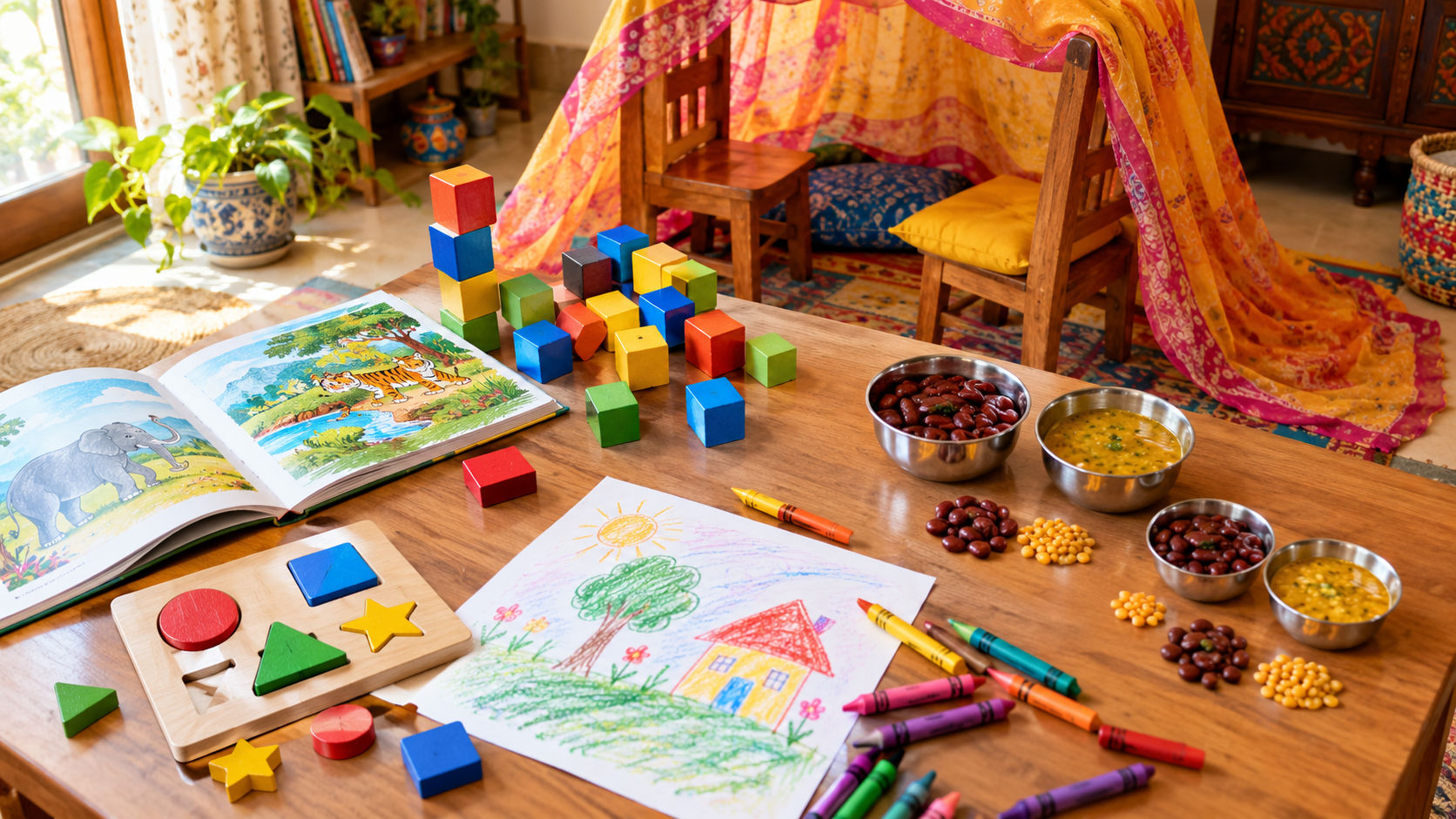
The five foundational self-care activities for 3–5 year olds are: practising buttons on an adult shirt, zipping a sealed bag of rice, pouring water between steel glasses, peeling a banana, and folding a napkin. Each builds fine motor control and independence—and you already have everything you need at home.
What's Happening at This Age
Between 36 and 60 months, your child is moving from being fully dependent to wanting to do things independently—what early childhood educators call the "I do it!" phase. According to the National Curriculum Framework for Foundational Stage (NCF-FS 2022), this is when children develop fine motor skills: the precise hand and finger movements needed for dressing, eating, and personal hygiene. They're also building executive function—the ability to follow steps, plan, and problem-solve.
Self-care activities aren't just about getting dressed or eating tidily. They're how children develop confidence, patience, and the understanding that they can do hard things. When a 4-year-old successfully zips their own jacket, they're learning not just a motor skill—they're learning "I am capable." This matters far more than speed or perfection.
Try This at Home
Activity 1: Button Practice on an Adult Shirt
You need: An old adult shirt or kurta with large buttons (buttonholes can be tricky; start with medium-sized buttons, ideally 1–1.5 cm wide), and patience. Lay it flat or hold it on your lap.
How: Show your child the button and hole once, then let them try. Don't grab their hands or "help" by doing it faster. If they get stuck, guide their thumbs to hold the button steady while fingers poke it through. Start with just one button. When they succeed, celebrate visibly—clap, smile, say it clearly: "You did it!" Repeat the next day with another button.
What it builds: Fine motor control (pinch grip), hand-eye coordination, left-right hand cooperation, persistence, and the confidence to tackle a multi-step task.
Easier: Use a shirt with very large buttons (>2 cm) or try buttonholes that are slightly loose. Harder: Use smaller buttons, or ask them to button while wearing the shirt (requires more body awareness).
Activity 2: Zip a Sealed Bag with Rice Inside
You need: A small ziplock pouch or drawstring bag (the kind used for snacks), and a handful of uncooked rice or dal. Fill the bag halfway, seal it loosely, then leave the zip partially open for your child to close.
How: Show the zip moving side to side gently. Let your child hold the bag steady with one hand (this is the often-forgotten step). With the other hand, they grasp the zip tab and draw it slowly from one end to the other. The rice inside makes a satisfying sound and gives tactile feedback. Praise the action, not the speed.
What it builds: Bilateral hand coordination (using both hands together for different jobs), fine motor precision, and the mechanics of how zippers work—useful for jackets, bags, and trousers later.
Easier: Use a large zip handle or loop; practise unzipping first (it's easier than zipping). Harder: Start with the zip fully closed and ask them to open and close it repeatedly, or use a smaller bag.
Activity 3: Pour Water Between Two Steel Glasses
You need: Two stainless-steel katoris or small glasses (steel is safer than glass and won't shatter if dropped), lukewarm water, and a tray or shallow basin to catch spills. Do this outdoors or on a mat.
How: Pour water into the first glass slowly while your child watches. Hand them the full glass and show them where the empty glass is. Encourage them to pour the water from one glass to the other. Their first attempts will spill—that's learning, not failure. Let them do it 5–10 times. The repetition is where skill lives. After a few weeks, try smaller glasses or add a funnel to pour through.
What it builds: Hand stability, wrist control, spatial awareness (understanding how liquid moves and fills space), and risk management (learning how much tilt is safe).
Easier: Use wide-mouthed containers or bowls. Harder: Use narrower glasses, add a small funnel, or time how long it takes (introduces focus and rhythm).
Activity 4: Peel a Banana
You need: A ripe banana (soft skin bruises less and is easier to peel) and a small plate or bowl.
How: Let your child hold the banana and show them how to pinch the skin near the top. Once a small gap appears, encourage them to peel the skin back using their thumbs. This is often messier and slower than you peeling it, but that's the point. They're learning the movement, the force needed, and that their hands can do something useful. Let them eat the fruit after—the reward is built in.
What it builds: Thumb opposition (using the thumb against fingers), controlled force—learning how much pressure is too much and how much is just right—and practical life skills that set them up for independent eating.
Easier: Choose a banana with a naturally split skin. Harder: Use fruit that requires more force, like separating orange segments.
Activity 5: Fold a Napkin into Quarters
You need: A cloth napkin or a simple cotton dupatta, and a flat table or floor space.
How: Lay the napkin flat. Fold one corner to the opposite corner slowly while your child watches. Then unfold and let them try. Once they manage the first fold, help them fold again (creating a triangle, then a smaller triangle). Don't expect perfect corners—what matters is the motion and the understanding that a flat object can change shape. Over weeks, they'll refine this.
What it builds: Spatial reasoning, planning (seeing the next step), hand-eye coordination, and preparation for other self-care tasks like folding clothes or handling fabric.
Easier: Use a larger cloth or a scarf; fold just once. Harder: Fold into smaller rectangles or introduce simple origami shapes.
What "Getting It" Looks Like
Your child is making progress when they: attempt the task without waiting for you to do it, keep trying even after small failures, show visible concentration (quieter than usual, focused eyes), and ask to repeat the activity later. They may not be perfectly neat or fast, and that's correct—the goal is effort and willingness, not flawless results. A 3.5-year-old may button one button in 2 minutes; a 5-year-old might button three in 90 seconds. Both are progressing.
When to Move On, and When to Ask
Most children show readiness for the next step after 4–6 weeks of regular practice (3–4 times weekly). If your child loses interest, pause for two weeks and return. If they can't manage a skill after consistent practice over two months, or if they seem frustrated beyond normal challenge, talk to your paediatrician—some children benefit from occupational therapy, and that's completely normal.
If You're Homeschooling
Weave these activities into your daily rhythm: buttons during morning dressing practice, pouring during lunch, peeling during snack time, folding after laundry. They're not "lessons"—they're real-life moments. Start the week with one activity, add another after three days, and rotate. By the end of four weeks, all five are woven into your routine without feeling forced.
What Helps at Home (Optional)
Every activity above requires nothing you don't already have. That said, some parents find that a few well-chosen tools make these skills easier to practise. A dressing board with working zips, buttons, and laces offers all five skills in one place. A step stool helps your child reach sinks for pouring practice. A child-size apron protects clothes during messy activities. And a simple wooden pouring set with matched cups (sized for small hands) adds interest to pouring practice. None of these are necessary—household items work just as well—but they can help keep your child engaged if interest starts to dip.
What Paediatricians Say
The Indian Academy of Pediatrics emphasizes that self-care skills aren't luxuries—they're essential for developing independence and confidence. Research shows children who practise these skills early often have easier transitions to school routines and better emotional regulation. The key: let your child lead the pace. Rushing or correcting every mistake erodes confidence.
- Focus on process, not perfection: A slow button and a spilled glass are both wins.
- Repetition is the teacher: A skill done poorly ten times builds more confidence than a skill done perfectly once by someone else.
FAQ
Our Top Picks

Skillofun Wooden Dressing Frame – Multi-Activity Board
- ✓ Why it fits: Combines buttons, zips, laces, and snaps—practise all five self-care skills in one frame
- ✓ Made from sustainable wood with non-toxic finishes
- ✓ Suitable for ages 3–6 years; each mechanism is real and fully functional
* We earn a small commission — at no extra cost to you.

Melissa & Doug Lacing Board – Multi-Skill Learning
- ✓ Why it fits: Thick wooden cards teach threading and hand coordination—prepares fingers for buttoning and zipping
- ✓ Includes 8 cards with thick strings; no choking hazard
- ✓ Strengthens bilateral hand coordination and fine motor control
* We earn a small commission — at no extra cost to you.
Wooden Pouring & Stacking Cups Set – Sensory Play
- ✓ Why it fits: Sized for small hands; teaches controlled pouring with water or dry materials like rice
- ✓ Set of 6 wooden cups, BIS-certified for safety
- ✓ Smooth, splinter-free finish; lightweight enough for 3-year-olds to lift safely
* We earn a small commission — at no extra cost to you.

Child-Size Cotton Apron with Adjustable Neck Strap
- ✓ Why it fits: Protects clothes during pouring, peeling, and folding activities—builds independence without worry
- ✓ Made from 100% cotton; machine-washable
- ✓ Adjustable neck and waist straps fit ages 3–6 comfortably
* We earn a small commission — at no extra cost to you.