
Can Prunes Help a Constipated Baby? A Gentle, Doctor-Smart Guide
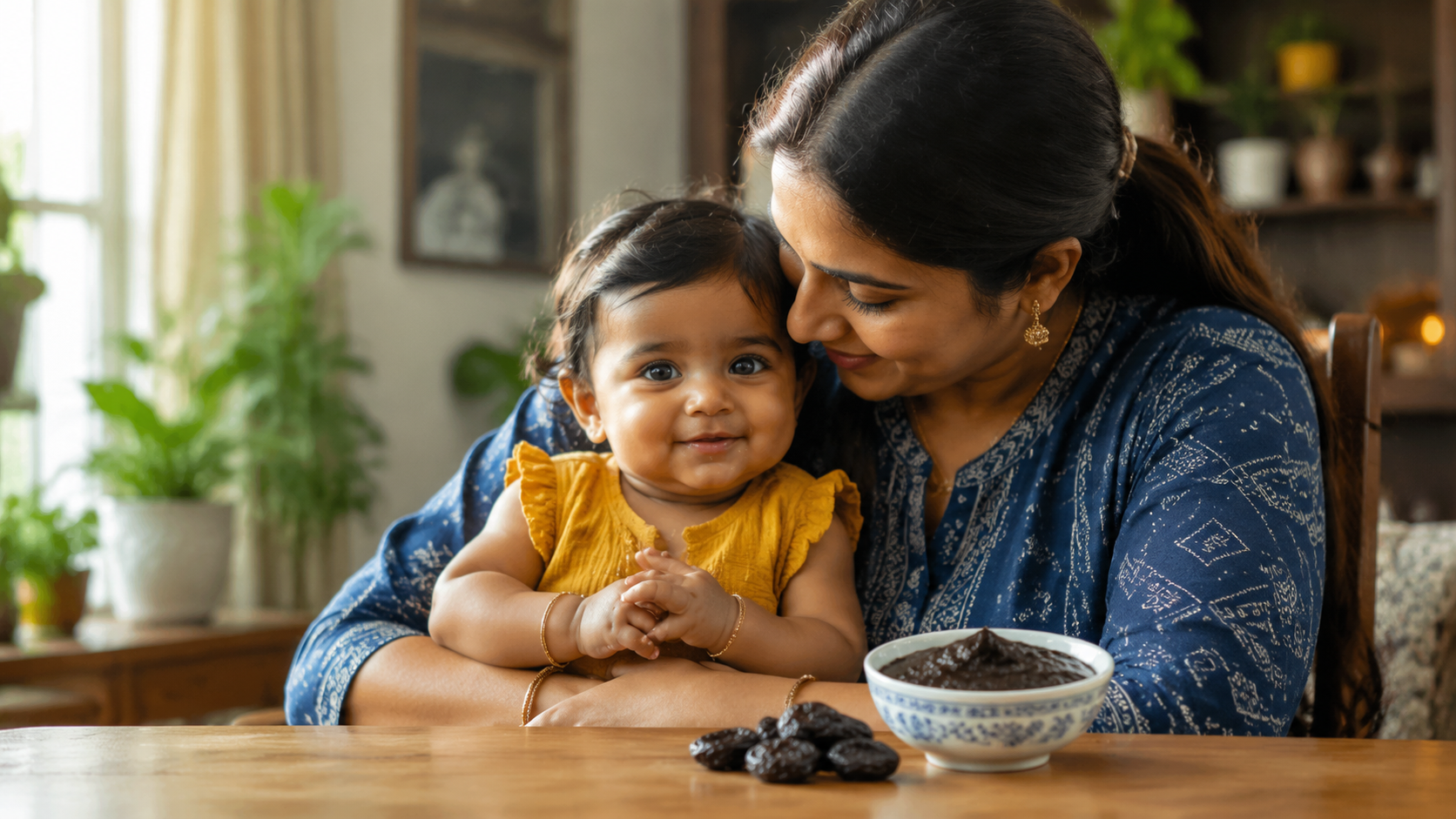
Short answer: prunes are one of the gentlest, most trusted foods for easing mild constipation in babies who have started solids, thanks to their fibre and natural sorbitol. They are a food, not a medicine, so they help gradually. Anything more than mild, occasional constipation should always be checked with your pediatrician.
Constipation is one of the most common worries once solids begin, and the reassuring news is that a simple food often helps before you need anything from a pharmacy.
Why starting solids changes things in the first place
Before solids, a baby's stool is shaped almost entirely by breastmilk or formula, both of which are easy to digest and tend to produce soft, frequent stools. The moment solids enter the picture, the digestive system has new work to do, breaking down fibre, starch and other components it was not handling before. It is completely normal for stool to become firmer or less frequent purely because of this shift, and this alone does not always mean something is wrong. Genuine constipation, where stools are hard, painful to pass, or noticeably less frequent than your baby's usual pattern, is different from this normal adjustment period, and it helps to know the difference before reaching for any fix.
Why prunes work when other fruits do not, quite as well
Prunes, which are dried plums, help in two ways at once, and this combination is what sets them apart. First, like many fruits, they contain fibre, both the soluble kind that absorbs water and softens stool, and some insoluble fibre that adds bulk. Second, and this is the more specific part, they naturally contain sorbitol, a type of sugar the body does not fully absorb in the small intestine. Because it stays in the gut, sorbitol draws a little water in with it, which softens the stool further and helps it move along more easily. Most fruits offer one of these effects, either fibre or a natural sugar alcohol, but rarely both in a meaningful amount. Prunes are unusual in offering both fibre and a meaningful amount of natural sorbitol in the same bite, which is why they have been the go-to fruit for this particular job for generations, well before anyone understood the chemistry behind why it worked.
| Fruit | Fibre | Natural sorbitol | Typically used for |
|---|---|---|---|
| Prune | Good source | Yes, naturally high | Easing mild constipation |
| Apple | Good source | Small amount | General fibre, gentler effect |
| Banana | Moderate | Very low | Can be binding for some babies, used differently |
| Pear | Good source | Yes, moderate | Also used for mild constipation, gentler than prune |
How much, and how often
For a baby who has started solids, a couple of teaspoons of smooth prune puree once a day is a reasonable starting point, adjusted based on how your baby responds. There is no need to increase the amount just because a little worked, more is not automatically better, and too much fruit sugar and sorbitol at once can occasionally cause loose stools in the opposite direction. If a small daily amount is not helping within a few days, that is a signal to speak with your pediatrician rather than simply increasing the quantity on your own.
How to offer prunes to a baby
- Start small, with a couple of teaspoons of smooth prune puree.
- Offer it once a day and watch how your baby responds over a day or two.
- Keep it real and simple, just prunes, with no added sugar or preservatives.
- Pair with a little extra water (small sips, for babies over six months) and some tummy time, which also help.
A ready-made prune puree made from real prunes with nothing added is an easy way to keep a gentle option in the cupboard for those days. Rorosaur Prune Delight is exactly that, real prunes with no added sugar or preservatives, so you can offer a small, clean spoonful when your baby needs a little help, without wondering what else might be in the jar.
Water and movement matter too
Prunes are often the headline fix, but they work best alongside two quieter habits. A little extra water, offered in small sips once your baby is over six months and already on solids, supports the same softening effect that fibre and sorbitol are doing from the inside. Physical movement, whether tummy time, crawling, or simply being less swaddled and more free to move, helps stimulate the digestive tract in a way that sitting still for long stretches does not. Neither of these replaces prunes, but combined with them, they tend to work faster than any single approach alone.
Other gentle helpers, and when to see your doctor
Alongside prunes, offering a little more water, keeping your baby moving with tummy time and crawling, and including other soft fibre-rich foods like pear and well-cooked grains can all ease things naturally. But prunes and these steps are for mild, occasional constipation only. Call your pediatrician if your baby has hard stools for more than a few days, blood in the stool, a swollen or painful tummy, is refusing feeds, or is under six months and not yet on solids. Do not give any laxative or medicine without medical advice, and do not rely on prune juice in large quantities as a substitute for whole prune puree, since juice concentrates the natural sugars without the same fibre content.
Our Top Picks

Rorosaur Prune Delight
- ✓ Made with real prunes
- ✓ A gentle source of fibre
- ✓ No added sugar or preservatives
* We earn a small commission — at no extra cost to you.