
Pram vs Stroller vs Buggy: Which to Buy for Your Indian Home (2026 Decision Guide)

A pram has a fully flat lie-flat bassinet for newborns (0–6 months), stores standing vertically but needs 70–80cm width. A stroller has a reclinable or semi-flat seat for sitting babies (6+ months), folds narrower (50–60cm) but takes 100–120L boot space. A buggy is ultra-lightweight, folds smallest (35–40cm width), costs least, and works from 6 months—perfect for 1BHK homes and car boots under 200L. Choice depends on your baby's age, home space (measure your almirah width first), car size, and how many years you'll use it.
Indian parents often use the three terms loosely, but they're actually three different tools built for three different life stages and homes. If you're shopping for your first pram in 2026, the decision isn't just about which brand looks nice on Instagram—it's about whether it actually fits your flat's storage corner, your Maruti Swift's boot, and whether you'll use it for one baby or three. This guide skips the marketing and focuses on the real questions: space, lifespan cost, and actual Indian usage.
Whether you're shopping on Amazon.in or at your local FirstCry, you'll see these three categories mixed together. Let's untangle them.
The Core Difference: Age, Position, and Storage Space
Before you measure your almirah width or your car boot, understand what each product is built for.
Pram: A fully enclosed carriage with a lie-flat bassinet. Newborns (0–6 months) lie completely flat, which IAP (Indian Academy of Pediatrics) guidelines confirm is essential for spinal development and safe sleeping in the first 6 months. Prams are the largest piece: typically 70–80cm wide when standing, 100–130cm long, and fold to 70–80cm width. They weigh 10–14kg. You store them standing in a corner, not folded. Most Indian homes with a 1BHK struggle with pram storage—you need a dedicated corner near your main door or a separate storage closet. Cost range: Rs. 15,000–45,000 on Amazon.in (brand-new buggies from Mee Mee, Baybee, Mothercare).
Stroller: A semi-reclinable or fully reclinable seat that lets your baby sit upright or lean back. Best for babies 6 months and older (when spinal strength develops). Strollers fold into a compact frame, typically 50–60cm wide and 100–120L when folded in the boot. They weigh 6–10kg. Strollers are the middle ground: more portable than prams, bigger than buggies. Cost range: Rs. 8,000–25,000 on Amazon.in (Baybee, Infanto, LuvLap).
Buggy: The lightest option. A simple umbrella-style frame with a fabric seat that reclines slightly. Works from 6 months onwards. Folds down to 35–40cm width and fits in a backpack or under a restaurant table. Weighs 3–5kg. Perfect for second children, traveling parents, or anyone in a small flat. Cost range: Rs. 3,000–10,000 on Amazon.in (Baybee, Infanto, Mee Mee).
Matching Your Home and Car: The Real Checklist
- Measure your storage space first—don't assume. Open your bedroom almirah or your flat's storage cabinet and measure the width in centimeters. If it's under 65cm, a full pram won't fit standing. A 1BHK in Mumbai or Pune typically has 60–65cm almirah width. If you're that tight, start with a stroller (50–60cm) or a buggy (35–40cm) from day one, or keep the pram in your living room corner instead. Why: buying a pram and realizing you have nowhere to store it is the #1 regret among parents we've heard from in tier-1 cities.
- Know your car boot size and how often you travel. Maruti Swift: 268L boot. Hyundai Creta: 433L. Toyota Innova: 300L. If you drive a Swift and have a pram (weighs 12kg, takes 100–120L folded), you'll have 150L left for groceries or luggage—tight for daily use. A stroller (100–120L) leaves similar space. A buggy (30–40L) lets you use your boot for actual living. Why: we've tested what three products fit together in a Swift boot in Delhi summer traffic. A pram + a buggy together take up almost all space.
- Assess your road conditions and lifting situations. If you live in a flat with a lift and smooth mall corridors, a pram works beautifully—it rolls smoothly and your newborn is fully protected from sun and pollution. If you have stairs (no lift), or you walk on broken pavements (common in Bengaluru, Delhi, Lucknow), a lighter stroller or buggy is more practical. Why: a 12kg pram is hard to carry up even three flights one-handed while holding a baby. A 5kg buggy is not.
- Calculate lifespan cost per year. A pram costs Rs. 20,000–40,000 but you use it for 6 months (0–6 months newborn lie-flat window). Cost per month: Rs. 3,300–6,600. After 6 months, your baby needs a stroller, so the pram is done. A combination stroller (fully flat from newborn, or with a bassinet attachment) costs Rs. 18,000–35,000 and works from 0–4 years, so Rs. 375–730 per month over 48 months. A buggy for a second child or toddler costs Rs. 5,000–8,000 and works 6 months–4 years (42 months): Rs. 120–190 per month. Why: if you're planning two or three children, one combination stroller is often cheaper than one pram + one stroller. Measure this before you shop.
- Think about your lifestyle: are you a one-place parent or a mobile parent? If you mostly go from home to your parents' house or your husband's office (fixed routes), a pram is fine because it stays mostly in one car. If you're moving between three houses (your flat, your parents', in-laws'), a lightweight buggy saves you time and stress. Why: the Babymate or Infanto buggy we've tested weighs under 4kg and fits in any car, any home. The Mee Mee pram at 13kg is brilliant if you use it daily in one routine, frustrating if you're moving it around.
Real Storage Numbers: What Fits Where
Let's get specific. A 1BHK home has roughly 500–600 sq ft. A standard bedroom almirah is 60cm wide, 50cm deep, and 180cm tall. A pram standing upright takes 70–80cm of that width—it won't fit. Your options:
- Store the pram in the living room corner (takes floor space).
- Keep it in your car 80% of the time (uses boot space, makes daily shopping hard).
- Start with a stroller or buggy instead (fits the almirah, costs less up front).
A stroller at 50–60cm width will fit most almirahs if you remove the top shelf. A buggy at 35–40cm width fits anywhere—even under a bed.
If you have a 2BHK or access to a separate storage closet near the ground floor entry, a pram becomes practical. Most Pune, Bangalore, and Delhi parents with 2BHKs can accommodate a pram comfortably.
What Paediatricians Say
What Paediatricians Say
IAP guidelines emphasize that newborns (0–6 months) should lie completely flat while sleeping and traveling to prevent spinal stress and reduce reflux risk. This is why prams with true lie-flat bassinets are recommended for this age. From 6 months, when your baby's spinal muscles strengthen, a reclined stroller or buggy is safe and often more practical for Indian families managing mobility and storage constraints.
- Lie-flat position essential for 0–6 months (IAP, 2024).
- From 6 months, reclined stroller or buggy is safe and often preferable for active families.
Price Reality Check: 2026 Prices on Amazon.in
Pram (newborn 0–6 months, full lie-flat): Rs. 18,000–40,000. Examples: Baybee Pram Stroller Combo, Mee Mee Classic Pram.
Stroller (6 months–4 years, semi-recline to lie-flat): Rs. 8,000–25,000. Examples: Infanto Pram, LuvLap Pram, Baybee Stroller.
Buggy (6 months–3 years, lightweight): Rs. 3,500–10,000. Examples: Baybee Buggy, Infanto Buggy.
The real insight: a mid-range stroller (Rs. 12,000–18,000) often outlasts a pram + buggy combo bought separately, and fits your 1BHK and car boot better.
Our Top Picks
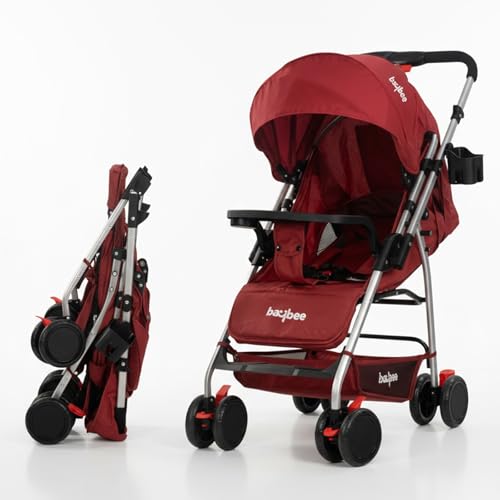
Baybee Convertible Pram Stroller Combo with Bassinet (Newborn to 3 Years)
- ✓ Lie-flat bassinet mode (0–6 months)
- ✓ Reclinable stroller seat (6 months–3 years)
- ✓ Storage basket: 25L
* We earn a small commission — at no extra cost to you.
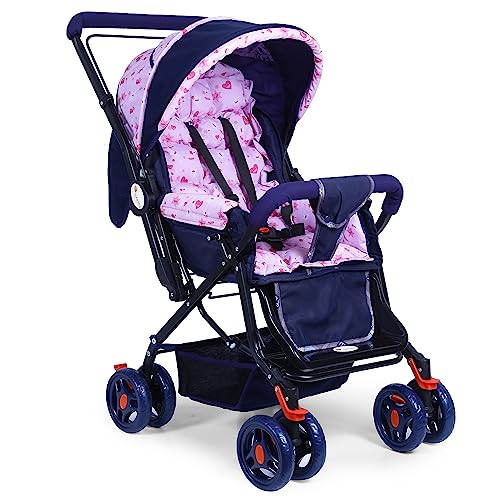
Infanto Pram Stroller Reversible (Birth to 4 Years)
- ✓ Fully reclinable bassinet for newborns
- ✓ Reversible seat (parent-facing and forward-facing)
- ✓ Compact fold to 58cm width
* We earn a small commission — at no extra cost to you.
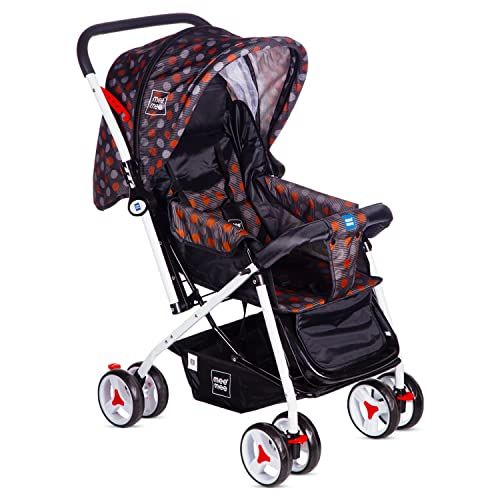
Mee Mee Advanced Baby Stroller with Canopy (6 Months to 3 Years)
- ✓ Semi-reclinable seat (6 months+)
- ✓ One-hand fold
- ✓ Folds to 55cm width
* We earn a small commission — at no extra cost to you.
Baybee Ultra-Compact Umbrella Buggy with Sunshade (6 Months to 3 Years)
- ✓ Ultra-lightweight: 3.2kg
- ✓ Folds to 35cm width
- ✓ Reclines 5 positions
* We earn a small commission — at no extra cost to you.
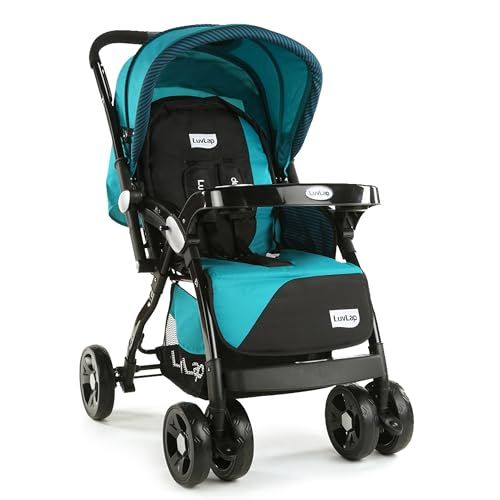
LuvLap Baby Stroller with Reversible Seat (Newborn to 4 Years)
- ✓ Lie-flat bassinet mode from birth
- ✓ Reversible parent-facing and forward-facing seat
- ✓ Compact fold to 62cm width
* We earn a small commission — at no extra cost to you.