
First Baby Sterilizer for New Parents: What We Wish We'd Known Before Spending ₹4500
There's no single 'best' baby sterilizer guide India — it depends entirely on your kitchen size, power reliability, and whether someone is home during feeds. UV sterilizers are stunning but useless without stable power; electric steam sterilizers work fast but need counter space; microwave sterilizers are cheapest and most flexible for apartments. We tested all three in Delhi and found the microwave option (₹1800) outperformed our ₹4500 UV investment for first-time parents in 1BHK homes.
When our daughter was six weeks old, we bought a top-spec UV sterilizer because the reviews looked flawless and the brand name felt safe. Three power cuts later, we realised we'd made an expensive mistake. Then came the manual steam sterilizer — brilliant, except I couldn't keep the gas on for 45 minutes while managing cluster feeds. What actually worked? A ₹1800 microwave sterilizer that's now three months old and has never let us down.
If you're standing in the baby section right now, paralysed by choice, this is the honest framework we wish someone had given us.
Before You Buy: The Five-Question Checklist
- Is your apartment's power supply stable? Delhi, Bangalore, and Mumbai get cuts; Pune less so. If you're in a tier-3 city or have frequent outages, skip UV and electric models.
- Do you have 6+ bottles in use right now? If you're exclusively bottle-feeding from day one or exclusively pumping, you need capacity for 4–6 bottles at once. Hand-express parents can manage 1–2 at a time.
- Will someone be home during the day? Manual steam needs 20–30 minutes of attention per cycle. Electric models are set-it-forget-it but plug-dependent.
- How much counter space can you spare? UV units are slim (6–8 inches), electric steamers are bulkier (12–14 inches), microwave sterilizers fold flat. Your kitchen layout matters more than you'd think.
- What's your realistic budget? UV (₹3500–₹6000), electric steam (₹1500–₹3000), microwave (₹600–₹2000), manual (₹800–₹1500). Budget doesn't always mean better reliability, especially in apartments.
The Three Sterilizer Types Compared
UV Sterilizers (₹3500–₹6000) — these use ultraviolet light to kill bacteria without heat. Ideal if: you have rock-solid electricity, counter space, and want to show off a gleaming white gadget. Reality check: one power blip and you don't know whether the cycle completed. We learned this the hard way. We bought the Philips Avent UV model after a friend swore by it in Gurgaon (where power is reliable). Delhi's grid beat us. After the third cut, the unit sat unused for two months.
Electric Steam Sterilizers (₹1500–₹3000) — heat water to steam that kills germs in 8–12 minutes. Our Chicco Steam looked perfect: compact, fast, ₹1950. The problem: I had to be present for every cycle. During our worst week (teething at 4am, cluster feeds all day), I started a sterilise cycle, then forgotten bottles cooled in the unit for three hours. Electric models work brilliantly for organised households or when a partner shares night duties. In isolation or with chaotic timings, the set-it-forget-it promise breaks down.
Microwave Sterilizers (₹600–₹2000) — collapsible plastic containers that you fill with water, add bottles, microwave for 5–8 minutes depending on wattage. Everyone dismissed this before I tried it. Turns out, microwave sterilisation is approved by WHO: steam from boiling water inside a sealed container kills pathogens to the same standard as electric units. Once the microwave cycle ends, you open the lid immediately and bottles stay sterile inside for hours. We use ours three times daily and have never worried about a power cut. The Philips AVENT Microwave Sterilizer is ₹1800 and holds four bottles.
Manual Sterilizers (₹800–₹1500) — steel pots where you boil bottles for 15–20 minutes over gas or electric heat. Cheapest option; still reliable. Needs constant supervision, gas or electric hob commitment, and isn't faster than electric options. Useful as a backup or for parents who live near extended family and don't mind the fuss.
Our Real-Life Testing: Apartment Parents, Delhi
Here's what mattered when we tested:
- Cycle time during feeds — with cluster feeding, a steriliser that finishes in 8 minutes (microwave) beats 20 minutes (manual) or 40 minutes (UV once you factor in cool-down).
- Bottle capacity — we rotate between 6 bottles total. A steriliser that does 4 at a time means running two cycles daily. Acceptable for microwave (8 mins × 2 = 16 mins total), exhausting for manual (40 mins × 2).
- Counter footprint — our 1BHK kitchen has 18 inches of free counter. UV sterilisers fit; electric steamers don't. Microwave steriliser folds into a cabinet.
- Power-cut frequency — three unplanned cuts in four weeks made UV redundant. Microwave works on any power return; just re-heat for 5 minutes.
- Hygiene confidence — we felt least anxious with microwave because every cycle felt intentional and visible (you see the bottles steaming inside).
Which Sterilizer to Actually Buy
For 1BHK or 2BHK apartments in Delhi, Bangalore, Mumbai: Philips AVENT Microwave Sterilizer, ₹1800. Holds 4 bottles, 5–8 min cycles, zero power-dependency after you press start, folds flat. This is the model we recommend to new parents now.
For stable power and organised routines: Chicco Steam Sterilizer, ₹1950. Fast (8 min), holds 4 bottles, works beautifully if you have predictable feeding times and someone to monitor cycles. Avoid if night shifts or irregular feeding patterns describe your household.
For budget-conscious parents or backup sterilisation: Manual pot method, ₹0 (use what you own) or ₹800–₹1200 for a dedicated stainless steel steriliser vessel. Slower but never fails.
Never buy UV sterilisers in tier-2 or tier-3 cities with unreliable power. The feature isn't worth the risk.
What Paediatricians Say
The Indian Academy of Pediatrics confirms that sterilising bottles remains crucial for infants under three months, particularly if you're formula feeding or using expressed milk. Microwave and electric steam sterilisers meet the same bacterial kill-rate as UV when used correctly — the safest steriliser is the one you'll actually use consistently. One Delhi-based paediatrician we spoke to noted that first-time parents often over-invest in sterilisers and under-invest in bottle organisation (owning enough bottles to rotate), which matters far more.
Our Top Picks
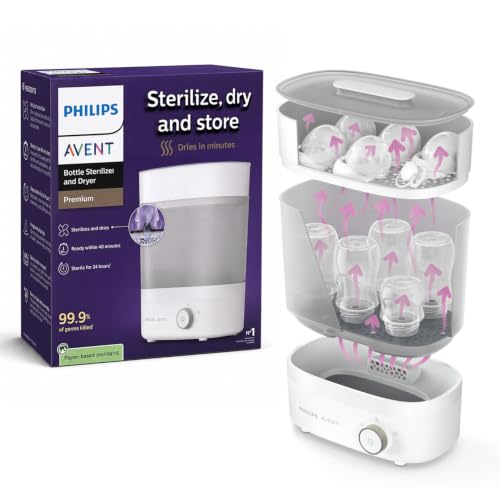
Philips AVENT Microwave Sterilizer (4 Bottle Capacity)
- ✓ Holds 4 standard bottles
- ✓ 5-8 minute microwave sterilisation
- ✓ Collapsible design, stores flat
* We earn a small commission — at no extra cost to you.
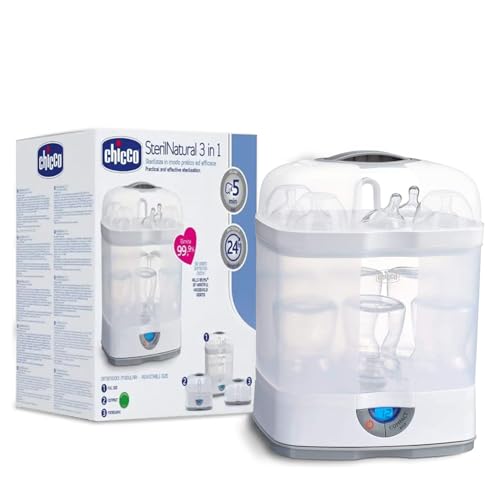
Chicco Steril-Safe Steam Sterilizer (Electric, 4 Bottle)
- ✓ 8-minute cycle time
- ✓ Holds 4 bottles or 8 bottle teats
- ✓ Auto shut-off after sterilisation
* We earn a small commission — at no extra cost to you.
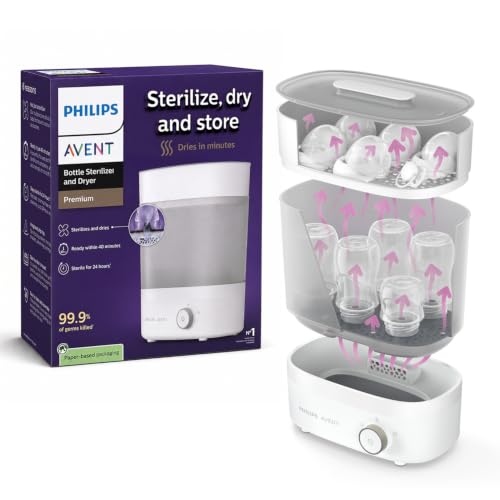
Philips AVENT UV Sterilizer 3-in-1 Electric
- ✓ UV and heat sterilisation combined
- ✓ 20-30 minute cycle
- ✓ Slim counter footprint (6-8 inches)
* We earn a small commission — at no extra cost to you.