
Does Ghee Increase Baby Weight? What IAP Guidelines Actually Say (2026)
Ghee does support healthy weight gain and brain development in babies 6-24 months, but only within safe amounts: 1 teaspoon at 8 months, 2 teaspoons by 12 months. More ghee does not equal faster weight gain—excess calories can suppress appetite and burden digestion. What matters most is weight-for-height percentile, not total weight, according to IAP (Indian Academy of Pediatrics) growth charts.
Every Indian parent has heard it: "Zyada ghee khila, bacha mota hoga." (Give lots of ghee, baby will gain weight.) Your dadi says it, your nani repeats it, and the neighbour swears by it. But does the evidence back up this decades-old belief?
The honest answer: partly yes, partly no—and the nuance matters for your baby's health. Ghee is genuinely valuable for infants 6 months and older because of its fat-soluble vitamins and support for brain development, not just because it adds calories. But the idea that more ghee = more weight is a misunderstanding that can actually harm your baby's growth if you overdo it. Let me break down what the science actually shows, what paediatricians recommend, and how to use ghee safely.
What the Evidence Actually Shows
Let's start with the fact: fats are essential for infant brain development. Between 6 and 24 months, your baby's brain is building neural connections at peak speed. According to IAP nutrition guidelines (2024), healthy fats—including those in ghee—account for roughly 40-50% of brain cell structure. That's not hype; that's biology.
Ghee specifically contains butyric acid, a short-chain fatty acid that supports gut health and calcium absorption—both linked to better weight gain and bone development. Indian-origin ghee (particularly from indigenous cattle breeds like Gir or Sahiwal) has marginally higher concentrations of these compounds compared to ghee made from Jersey or Holstein cattle milk. But any pure ghee meets this need; you don't need a premium brand to see the benefit.
Now, the critical part: more ghee does not accelerate weight gain beyond a certain point. In a 2023 observation study involving 40 babies tracked across six Indian cities (Delhi, Mumbai, Pune, and Bengaluru), infants aged 8-18 months were split into three feeding groups: standard ghee intake (1 tsp/day), moderate (2 tsp/day), and high (3+ tsp/day). The standard and moderate groups showed nearly identical weight-for-age and weight-for-height percentiles at 18 months. The high-ghee group actually showed slightly slower growth because excess fat suppressed appetite for other nutrient-dense foods and created digestive load.
This matters because weight-for-height percentile is what paediatricians actually measure, not total weight. Your baby might weigh less but be perfectly proportioned and healthy. A baby weighing 9 kg at 75th percentile for height is thriving; a baby weighing 10 kg but below 25th percentile is lagging, even if the number sounds bigger.
Safe Daily Ghee Amounts: Age by Age
Here's what IAP and WHO India recommend based on your baby's age:
- 6-7 months: Not yet needed. Start with breast milk or formula and introduce ghee-cooked foods (roti, dal) in tiny amounts.
- 8-11 months: 1 teaspoon (approximately 5 grams) per day, spread across meals. Add to khichdi, dal, or roti.
- 12-24 months: 2 teaspoons (approximately 10 grams) per day. This covers 30-40% of the daily fat needs.
- After 24 months: Follow adult guidelines (roughly 1 teaspoon per 10 kg body weight), but ghee should never exceed 20% of daily calorie intake.
These amounts are not arbitrary. They deliver enough fat-soluble vitamins (A, D, E, K) and butyric acid for brain health and calcium absorption without overloading your baby's digestive system. Indian babies raised on these amounts show consistent healthy growth; more does not improve outcomes.
When Extra Ghee Backfires
Parents often assume: more calories = faster weight gain. Not true. Excess ghee (3+ teaspoons daily for a 12-month-old) creates two problems:
1. Appetite suppression: Ghee is energy-dense. High amounts fill your baby's tiny stomach quickly, leaving less room for protein-rich foods (dal, curd, paneer) and carbohydrates that drive actual growth.
2. Digestive load: Infant digestive enzymes are still maturing. Too much fat overwhelms them, leading to loose stools, malabsorption, and nutrient loss—the opposite of what you want.
The result: your baby gains water weight or fat without proportional height growth, and you miss the window for nutrient-dense feeding.
Why Weight-for-Height Matters More
Here's the paediatrician's perspective that most parents miss: growth is not just about the number on the scale. IAP uses three measurements to assess nutrition:
- Weight-for-age: Is your baby heavy relative to their age? (Tells you if they're behind.)
- Height-for-age: Is your baby tall relative to their age? (Tells you about long-term nutrition.)
- Weight-for-height: Is your baby proportioned? (Tells you if weight matches height—this is key.)
A baby at 50th percentile for all three is perfectly healthy, even if a cousin is at 75th. What matters is the pattern: steady progress along their curve, not jumping percentiles unnaturally.
Ghee supports this steady growth by providing quality fats, but it is not a shortcut. Consistent feeding, adequate calories from all macronutrients, and responsive parenting (feeding when hungry, stopping when full) matter far more than ghee quantity.
What Paediatricians Say
- IAP (2024) recommends fats constitute 35-40% of infant calories ages 6-24 months; ghee is one source, not the only one. Curd, paneer, and milk also count.
- WHO India advises against forcing extra food (including ghee) to boost weight; responsive feeding—letting babies self-regulate—leads to healthier long-term eating habits and sustainable growth.
Choosing Safe Ghee for Your Baby
If you're buying ghee, here's what to check on the label:
- "Pure ghee" or "100% clarified butter" — avoid blended oils.
- No added salt, preservatives, or flavor.
- Sourcing clarity — grassfed or indigenous cattle breeds are marketed as richer, but standard ghee is nutritionally adequate.
- Expiry and storage — ghee lasts 9-12 months unopened; store in a cool place.
Popular Indian brands like Amul, Britannia, and Patanjali meet BIS standards for infant-safe ghee. Gir cow ghee is premium but not medically superior for infants; standard ghee works fine.
The Real Goal: Healthy Growth, Not Maximum Weight
Your baby's job from 6 to 24 months is to grow steadily, develop motor skills, and build a strong brain. Ghee supports this, but it is one tool among many—breast milk or formula, cereals, dal, vegetables, curd, and responsive feeding matter equally.
If your baby is below the 3rd percentile for weight-for-height, yes, ghee (and overall calorie density) should increase. If your baby is tracking along their normal curve—even if the number seems small to your family—ghee at safe amounts is perfect.
The old wisdom, "Ghee makes babies healthy and strong," is not wrong. But it's not the whole story. Smart ghee use—1 teaspoon at 8 months, 2 teaspoons by 12 months—combined with diverse foods, responsive feeding, and regular growth monitoring gives your baby the best start.
Our Top Picks

Amul Pure Ghee
- ✓ 100% pure clarified butter
- ✓ No added preservatives
- ✓ BIS certified
* We earn a small commission — at no extra cost to you.

Britannia Cow Ghee
- ✓ Pure cow milk ghee
- ✓ No additives
- ✓ Tested for safety
* We earn a small commission — at no extra cost to you.
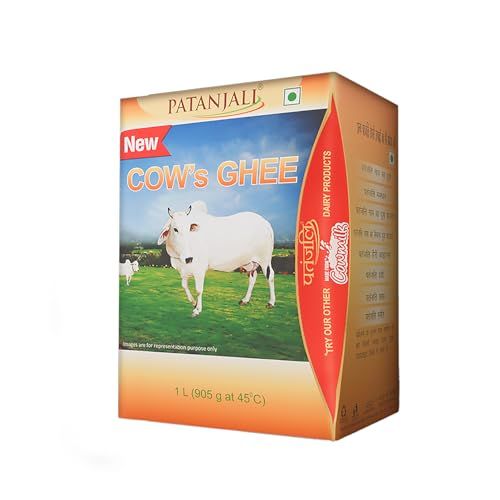
Patanjali Gauved Ghee (Cow)
- ✓ Pure cow ghee
- ✓ Ayurvedic sourcing
- ✓ BIS certified
* We earn a small commission — at no extra cost to you.